Scope the need
A React interface sends conversation actions to the intent-agent on AgentCore Runtime. The draft is stored in S3 and the conversation context in AgentCore Memory.
A conversational scoping process turns a software need into a structured intent, then triggers the tracked generation of three SDLC deliverables: requirements, software design and user stories.
The solution separates the user conversation from the document-generation pipeline. Each service has a clearly defined responsibility.
A React interface sends conversation actions to the intent-agent on AgentCore Runtime. The draft is stored in S3 and the conversation context in AgentCore Memory.
After review, the user submits the intent. Creating the final file in S3 triggers EventBridge, which starts the Step Functions execution.
The workflow orchestrates the requirements, software design and user-story steps in order. Each deliverable is produced by the generate-agent on AgentCore Runtime and written to S3.
Step Functions updates the job and step statuses in DynamoDB. The interface retrieves progress through the JOB_STATUS action and displays it to the user.
Events and object references connect the user journey to asynchronous processing, without making the conversational agent responsible for sequencing deliverables.
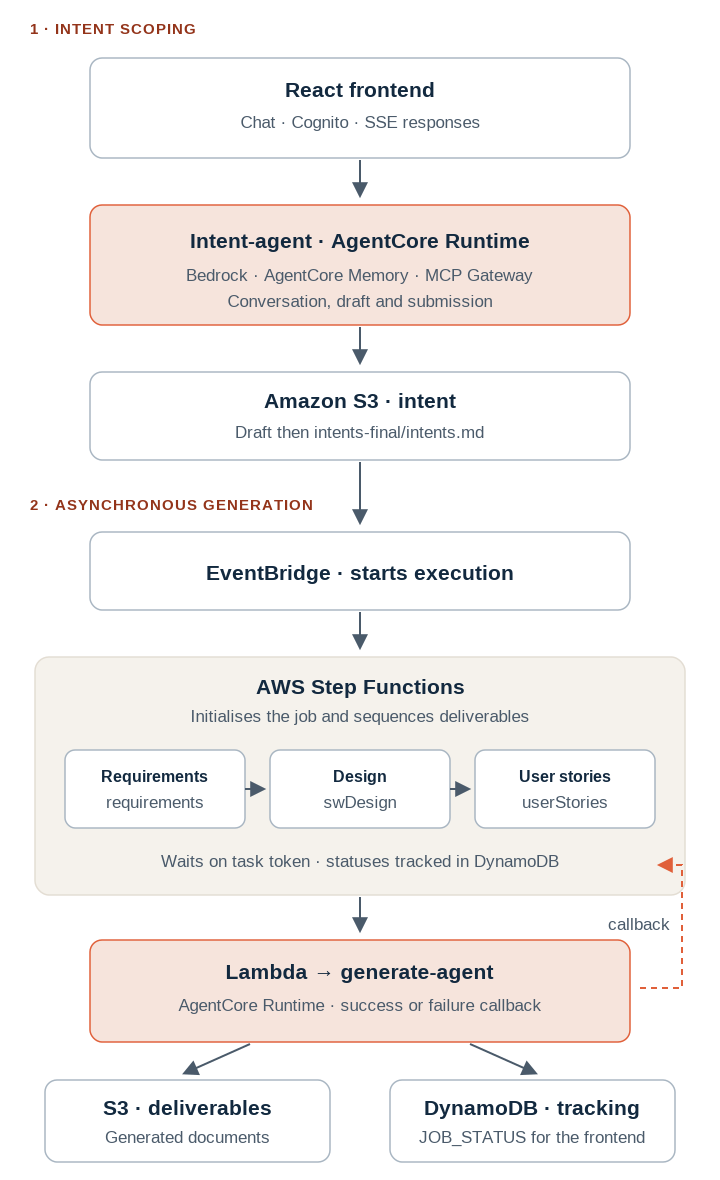
The React frontend calls POST /invocations on the intent-agent. Conversation and status responses are streamed over SSE. AgentCore Memory retains context; the MCP Gateway exposes the S3 storage operations used by the agent.
On submission, the intent-agent writes the final intent to S3. EventBridge detects creation of the object matching */intents-final/intents.md and starts a Step Functions execution.
Step Functions initialises the job, then runs the requirements, swDesign and userStories steps in sequence. A Lambda passes each generate-agent the relevant S3 references and a task token; the agent then reports success or failure through a callback.
DynamoDB exposes the current status of the job and each step. After submission, the frontend checks status every seven seconds; the intent-agent finds jobs associated with the intent and returns their status to the interface.
Explicit orchestration makes it possible to track work beyond a conventional invocation and makes state transitions visible.
Dependencies are defined in the workflow: design follows requirements, then user stories. The interface and intent-agent do not need to manage this sequence.
Step Functions waits for asynchronous processing with waitForTaskToken. The agent sends heartbeats while working, followed by a success or failure callback.
S3 remains the repository for intents and deliverables. DynamoDB stores an operational view of jobs; services primarily exchange object keys rather than the files themselves.
A dedicated page explains the trigger, task-token callbacks, status management and the role of Step Functions in this SDLC pipeline.